Still Feed · 虚室生白
A design research project on tangible LLM interfaces and artificial mindfulness · Prototype · in progress
“虚室生白,吉祥止止。
An empty mind breeds pure enlightenment; total stillness attracts boundless blessings.”
Less, on purpose
Most AI interfaces add: more text, more answers, more notifications. They pour out words faster than we can read them. They connect to everything, our email, drive, calendar, notes, GitHub and Slack, and now arrive as several agents running tasks in parallel threads, behind the same little sparkle icon that has appeared in almost every piece of software. All of it competes for the same small supply of attention, and at some point we burn out. Are we more productive, or has starting a half-baked task simply become so easy that we've stopped paying attention to what we read and do, doing for the sake of doing? Today's LLM interfaces don't make life easier. They make it busier.
I couldn't stop wondering about another way to live with AI. Could AI be passive, and stay in the background? Could an interface to AI show less, not more? Could it be tangible, free of screens, and even a pleasure to live with? So I tried the opposite. What if an AI read everything for you, the weather, your calendar, your body and your intentions, and gave back almost nothing? Just enough to set the tone of a day, quiet enough to ignore, and beautiful enough to leave on the wall.
The thing I'm making
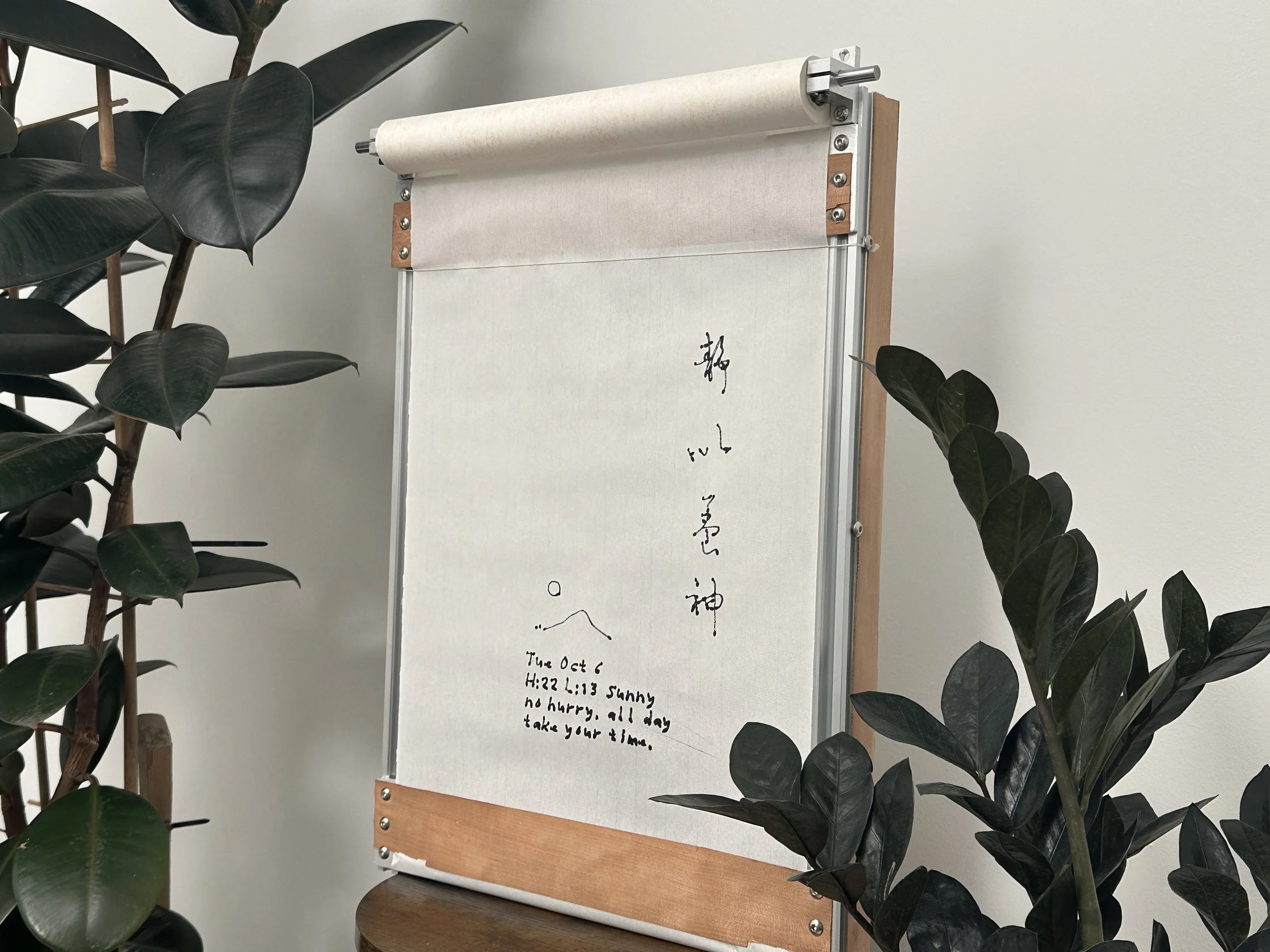
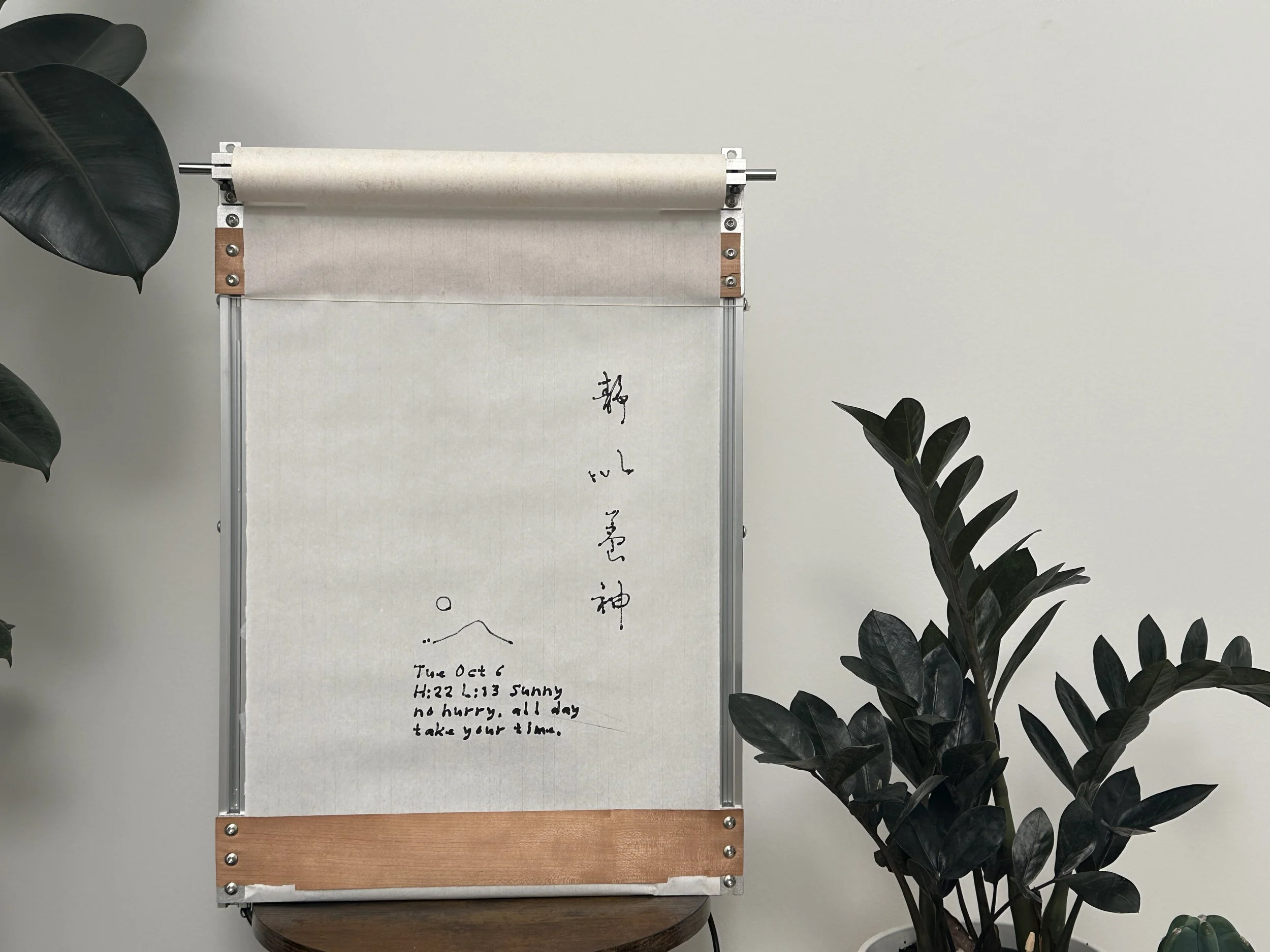
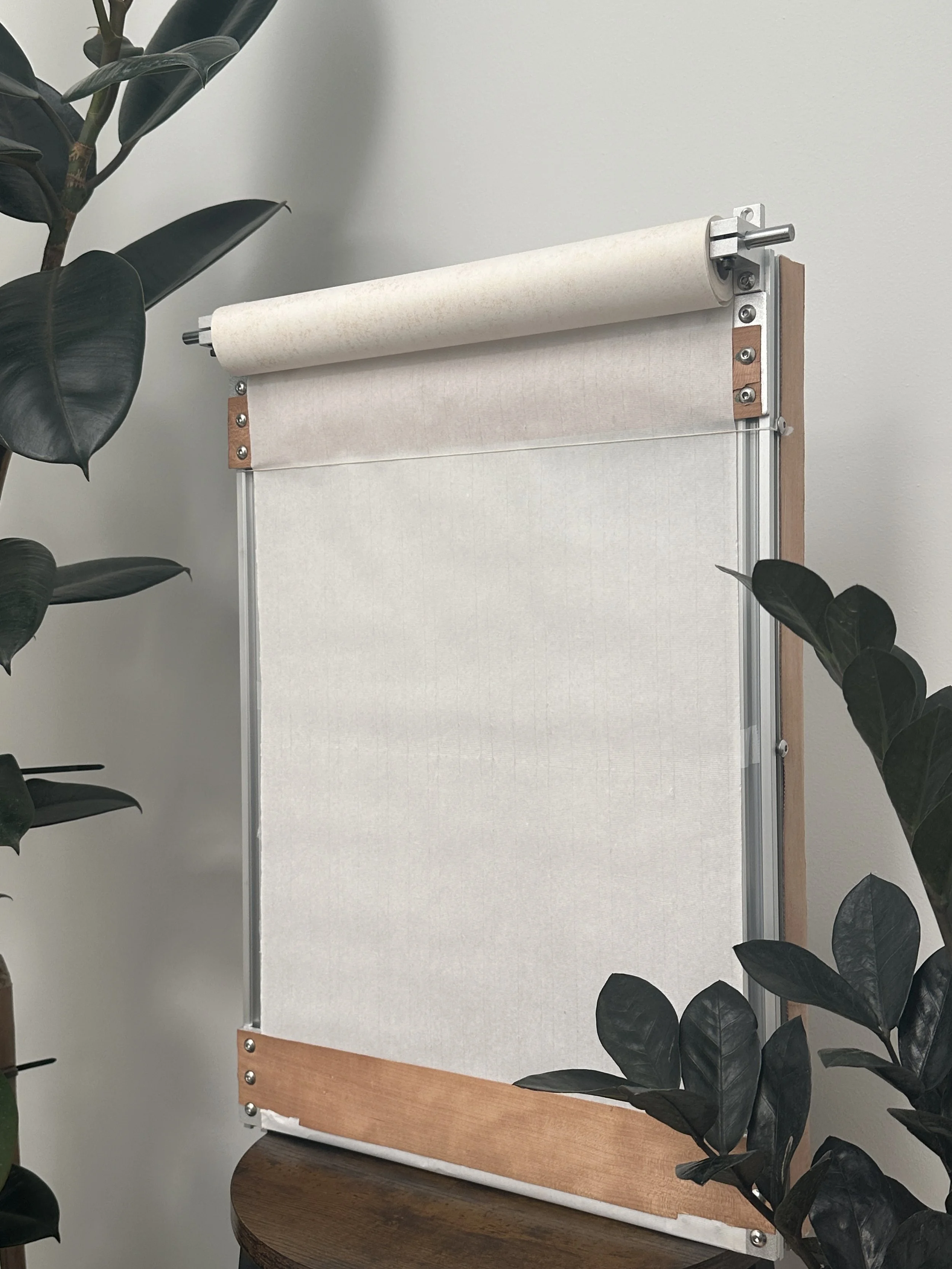
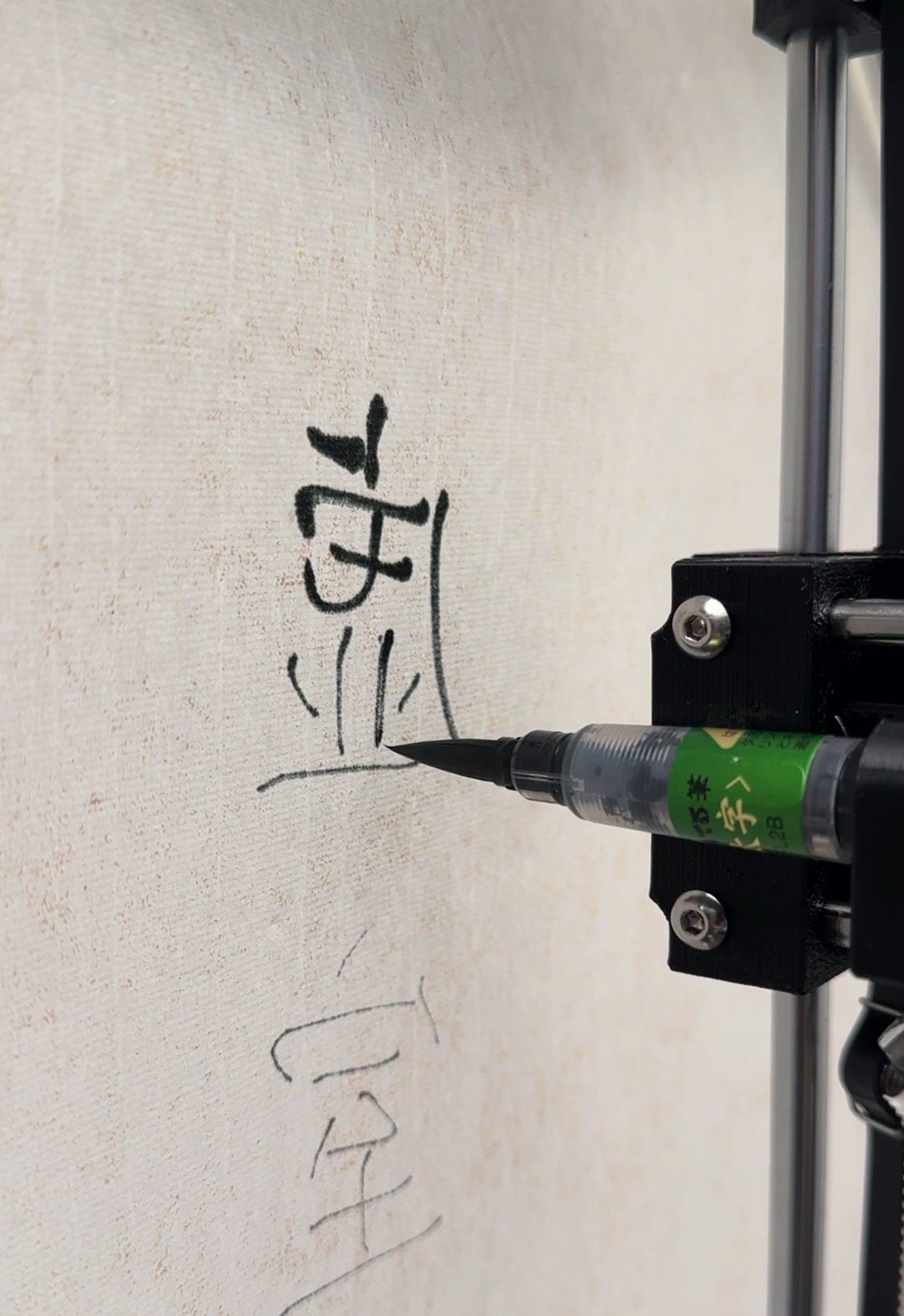
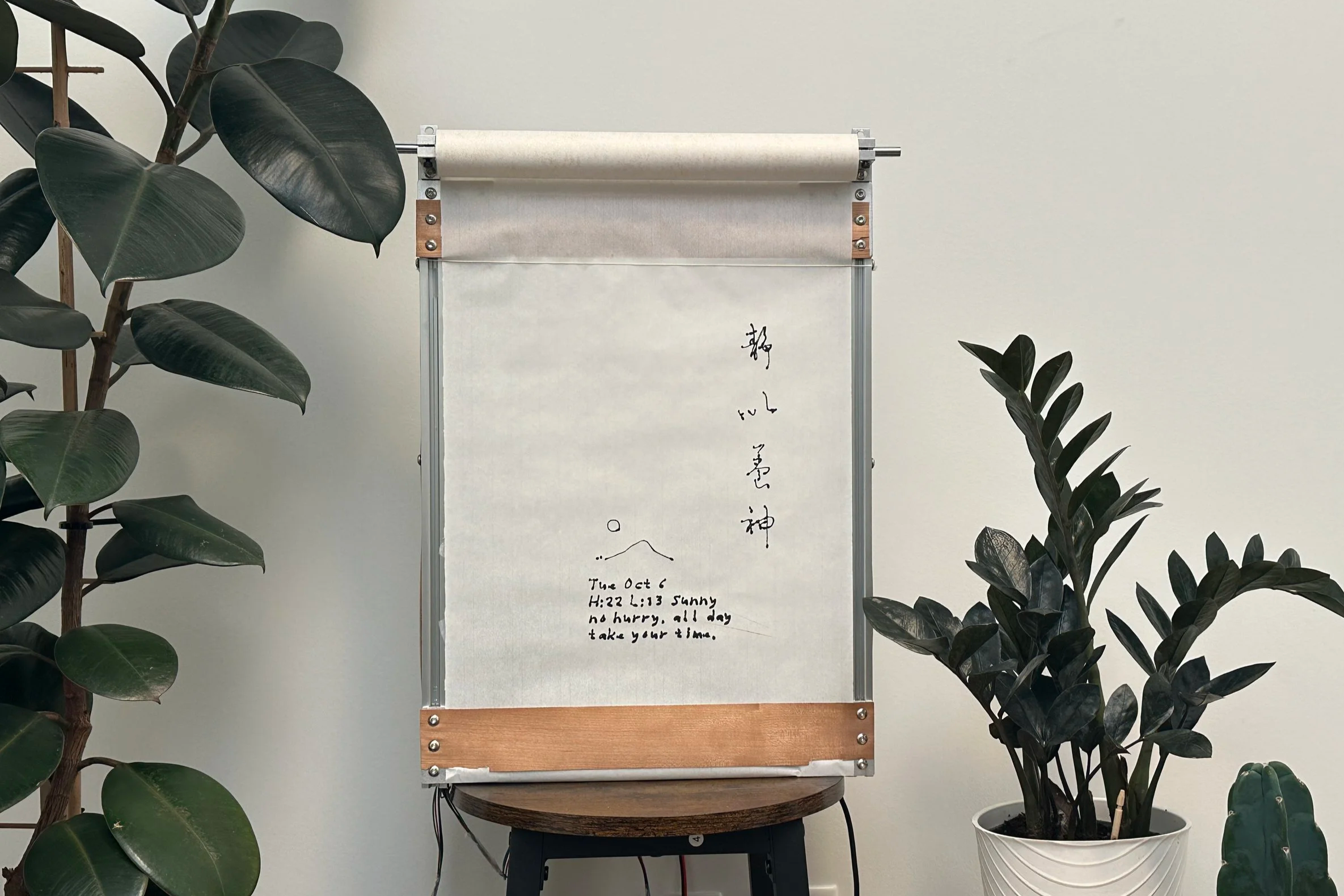
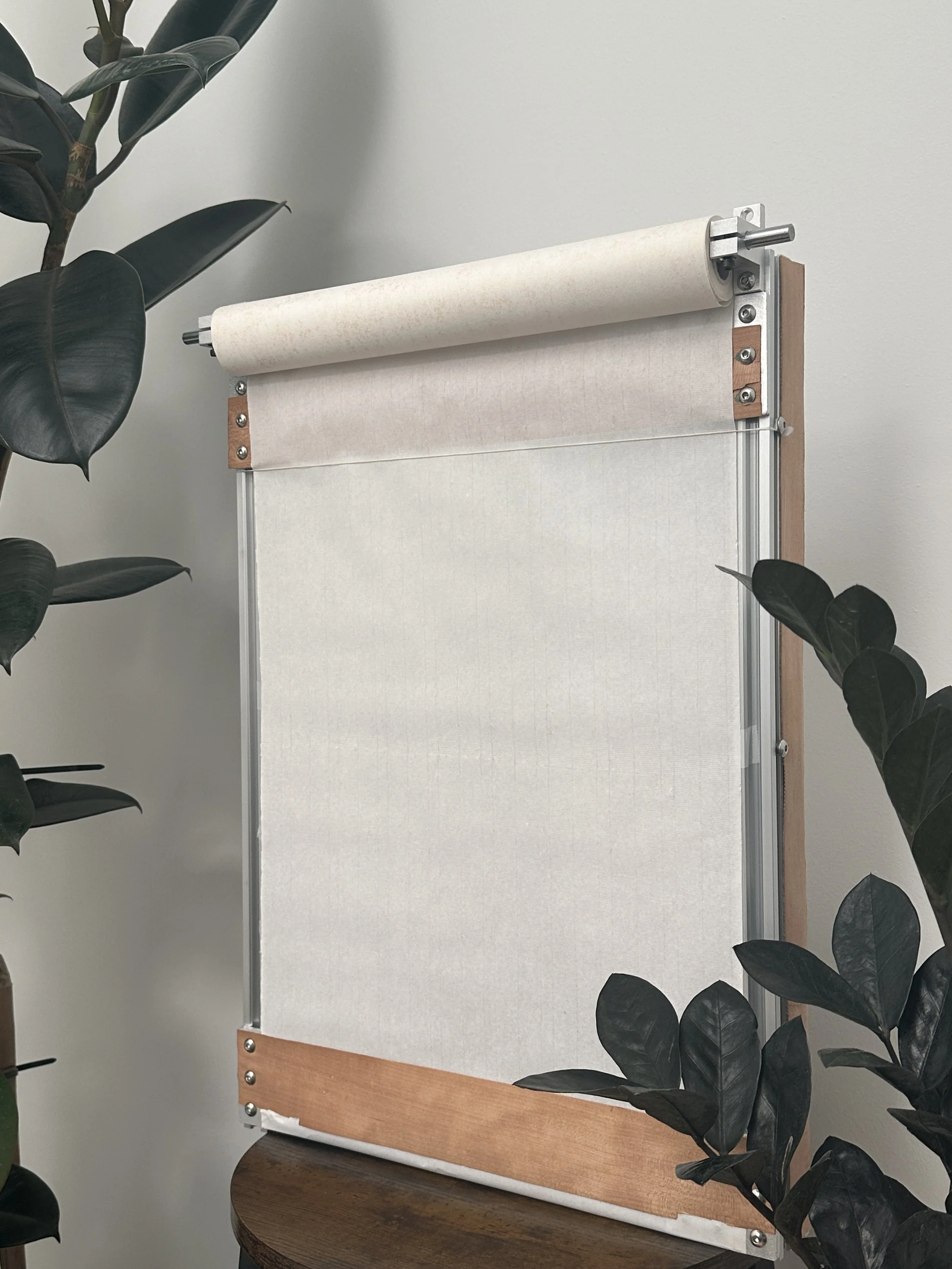
So my attempt is STILL FEED (虚室生白), an ambient AI frame that reads your day and writes it back in ink: usually a few words, sometimes a timeline of the day, sometimes a circle that invites you to breathe. A machine hidden behind a hanging scroll writes slowly in actual ink, and the characters seem to rise out of the paper on their own slowly but firmly. With one of our oldest tools, pen on paper, I want to use the power of AI in a calm and subtle way: to treat what gets shown with great care, and to make room for a moment of stillness. I call this artificial mindfulness.
It is not an app that throws information in your face, scores you against benchmarks, or tells you to meditate. It is a machine that practises restraint on your behalf, it reads more than it writes, writes slowly, and is allowed to say nothing at all.
Interfaces for artificial mindfulness
Home is where most of life happens. It holds our energy, our emotions, our routines and our time with each other. It is also where an ambient AI interface is needed most: a safe, personal space that we are deeply attached to and where we spend much of our time. Yet as homes fill with connected devices, they also fill with screens, speakers and gadgets, and grow more complicated than ever. These devices are smart, loud, bright and easy to use, but they are built to pull attention toward themselves. Here I propose tangible interfaces that let information live at the edge of attention instead, they tend to be soft, present in the room, readable at a glance, and easy to leave alone.
So I propose three qualities for ambient AI interfaces, one each for what they show, how they show it, and what they know:
Mindful: what it shows. They read more and display less. Out of everything they know, they choose the one or two things that matter the most, and are allowed to say nothing at all. Silence counts as an answer.
Non-invasive and multi-sensory: how it shows it. They wait to be glanced at rather than demanding to be looked at. No screen, no notification, no glow. Ideally, they should be something you can touch and feel.
Human-connected: what it knows. They know the person, not just the person’s tasks. A calendar holds obligations, but a person also has priorities, intentions, moods and a body. They want time to be creative, to rest and to be with family, not only to get through a list. These interfaces learn all of that and keep that picture up to date as you change.
With these intentions, I designed four ambient AI interfaces for Still Feed: the Dashboard, the Line, the Almanac and Breathe.
The Dashboard:
how should I start?
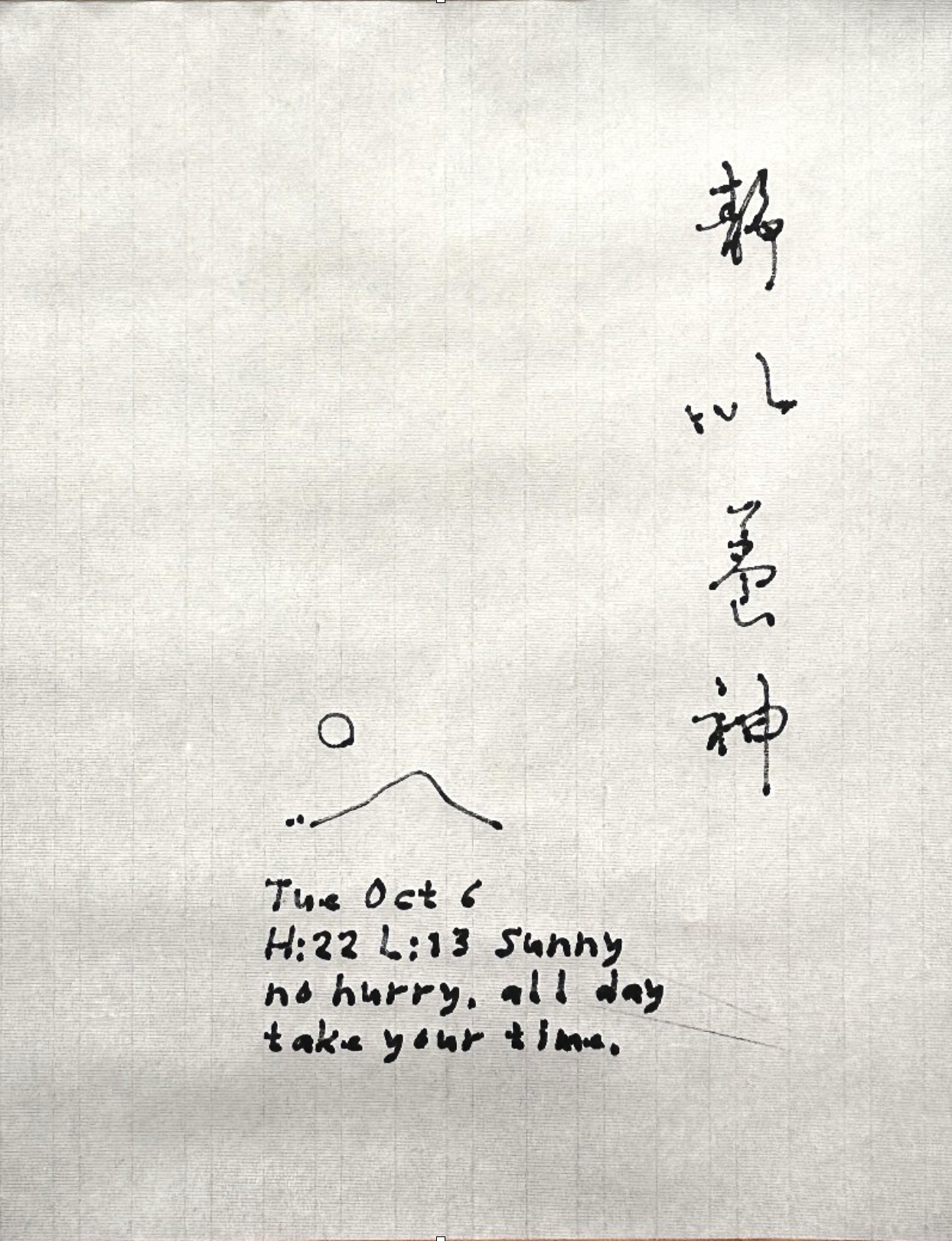
The dashboard is the default sheet. A scheduled LLM task runs at set times of the day. It pulls in everything the day holds, the weather, my calendar and my WHOOP data, and decides what the sheet should say.
But a calendar only knows the general tasks I have to do. So the model also draws on a deeper picture of me as a person, from two sources: my personal Obsidian vault, where my notes, plans and reflections live, and long-form interviews an AI holds with me every so often about what I'm working towards and what I want more time for. It weighs the day against that picture, keeps at most three priorities, puts what I want ahead of what merely asks for me, and leaves the rest off the sheet. The aim is not a complete to-do list. It is to protect my focus and my intentions, so the day starts from what matters to me rather than from whatever arrived overnight.
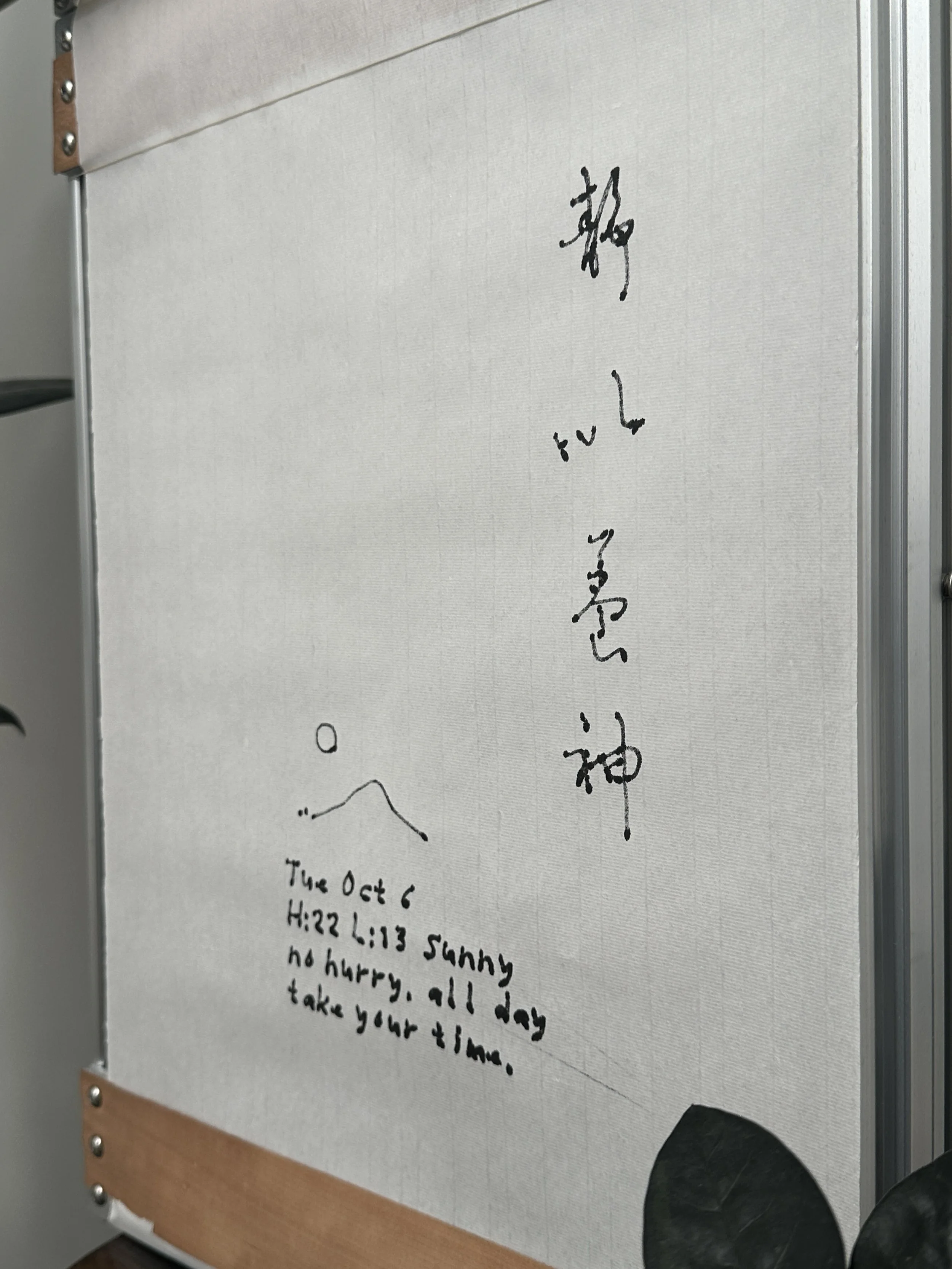
At the top of the sheet, it leaves me a hint for the day in four Chinese characters: on a clear Tuesday with nothing booked, 静以養神, meaning be still to nourish the spirit.
Why four characters? Chinese has long used just a few characters to hold a lot: chengyu idioms, the banner over a doorway at New Year, the names of the 24 solar season terms. Written as calligraphy, they also gain a poetic quality that suits stillness: the ink, the pauses between strokes and the empty paper around them say as much as the words do. Together, the format asks the AI to paint the gist, not the literal detail, and leaves the reader room to finish the meaning.
The Line:
when am I free?
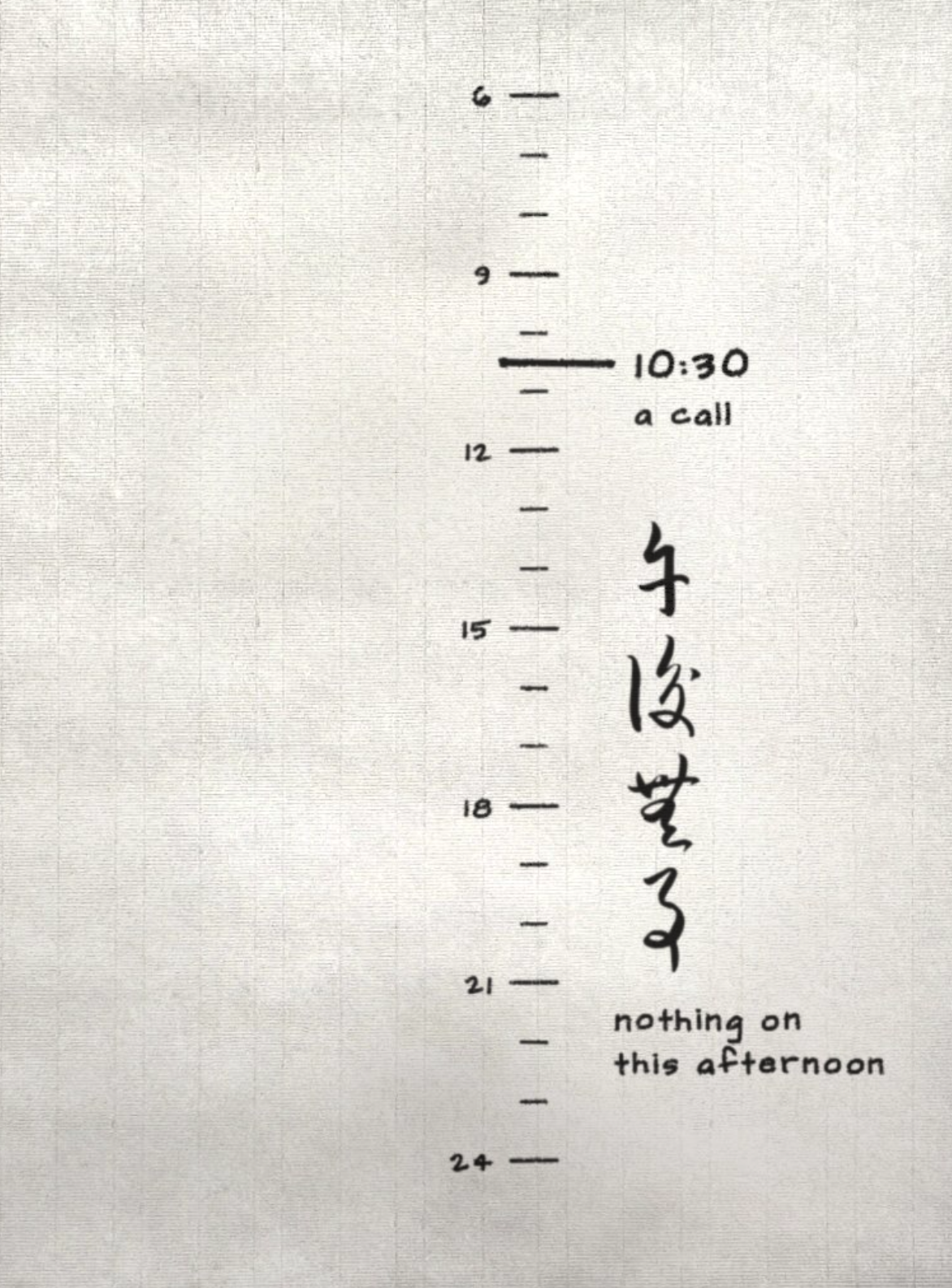
Some days have just a few fixed appointments, like a 10:30 call, with open time around them. On those mornings the frame draws the day as a ruler, with a short mark for every hour from six in the morning to midnight, and a longer one every three hours with the hour written beside it. Each commitment is a single heavy dash with its time. Everything else stays open paper.
The sheet doesn't list what I have to do. It shows how much of the day is still mine. One idea I want to test is that the most useful thing the frame can say might be nothing at all, 无事, "nothing pressing." We reach for our phones because we're afraid of missing something. A trusted "nothing needs you" on the wall could be what lets the phone stay in the other room.
The Almanac:
what does my body allow?
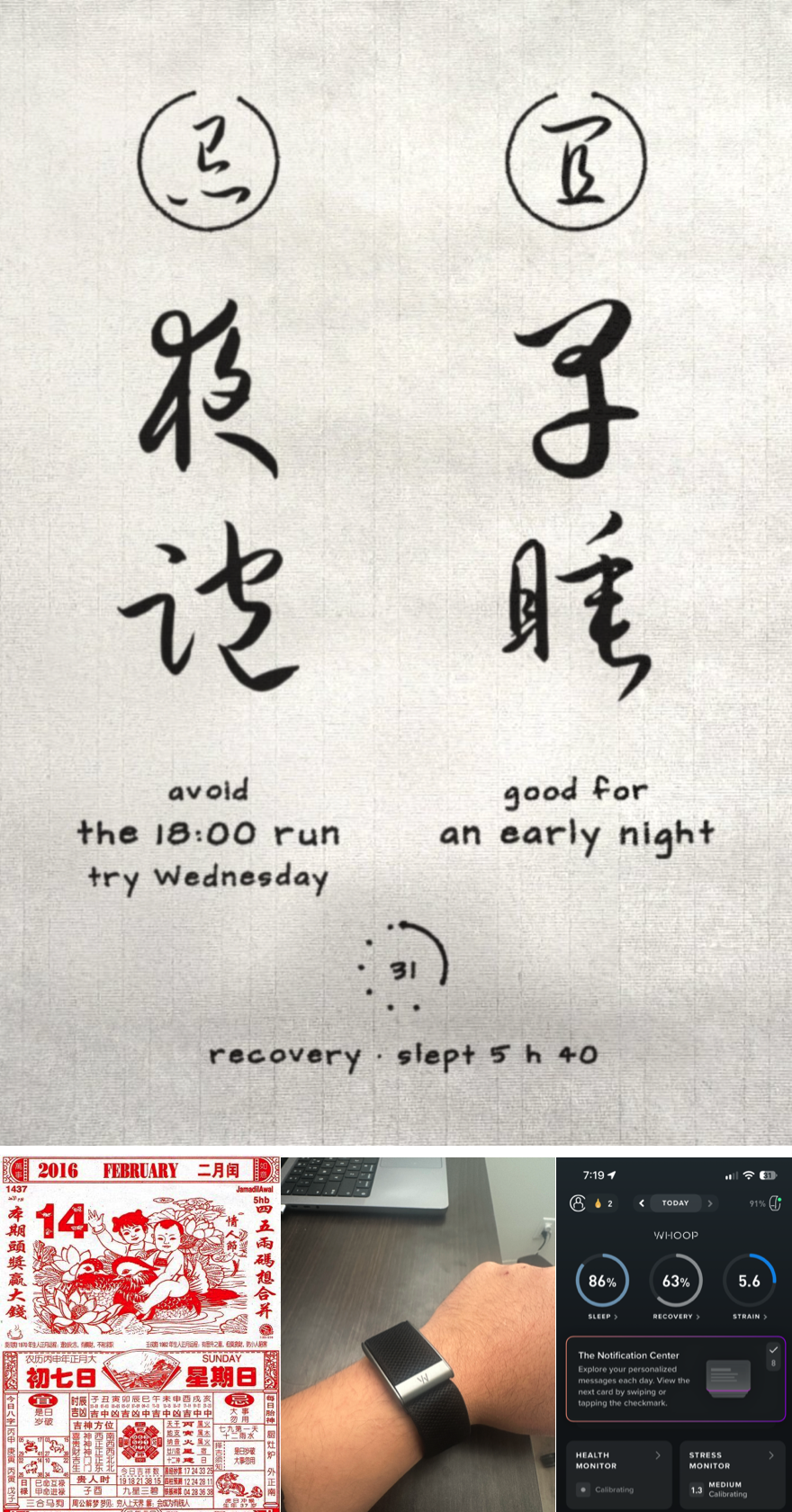
This sheet is inspired by the old Chinese almanac (黄历), which lists, for every day, what it is good for (宜) and what to avoid (忌). I connect that idea to how my body feels, using my WHOOP data, and draw my recovery as a ring that runs only as far as the score.
This sheet keeps the form and changes the source. My WHOOP strap scores each morning's recovery from heart-rate variability, resting heart rate and sleep. WHOOP's API shares that score, along with sleep and strain, and can tell the frame the moment the night has been scored. When recovery is in the red (1–33%) or the green (67–99%), the body has something to say, and it goes ahead of the calendar.
Breathe:
can I stop for a minute?
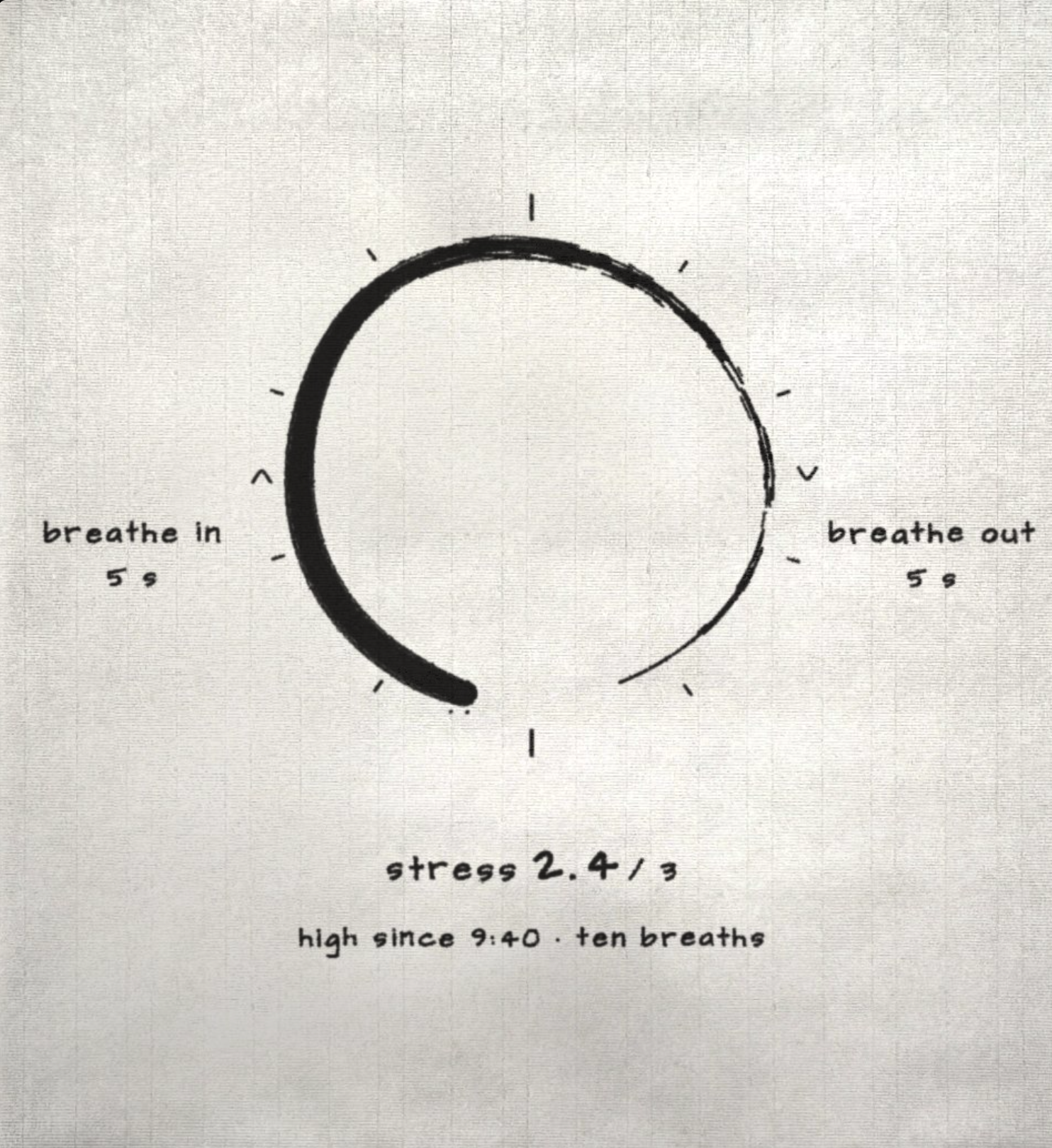
Wearables like WHOOP also track stress through the day. WHOOP uses a scale from 0 to 3, where 2 and above counts as high. When stress runs high, at any hour, the frame doesn't wait for the next morning to draw, it simply feeds a fresh sheet.
WHOOP keeps its stress score inside its own app and doesn't share it with other devices, so for now the frame relies on the next best signals, which is a very low recovery score in the morning, or simply a tap on my phone when I notice I'm overwhelmed.
To make room for a meditative moment, this sheet is almost all drawing. The brush pen draws an ensō, the Zen circle made in a single stroke, then keeps circling just above the paper at the pace of a breath. There isn't much to read, only a circle to follow. It doesn't tell me to relax or force me to stop. It simply makes something slow happen in the room, and I can join in or not.
How it's made
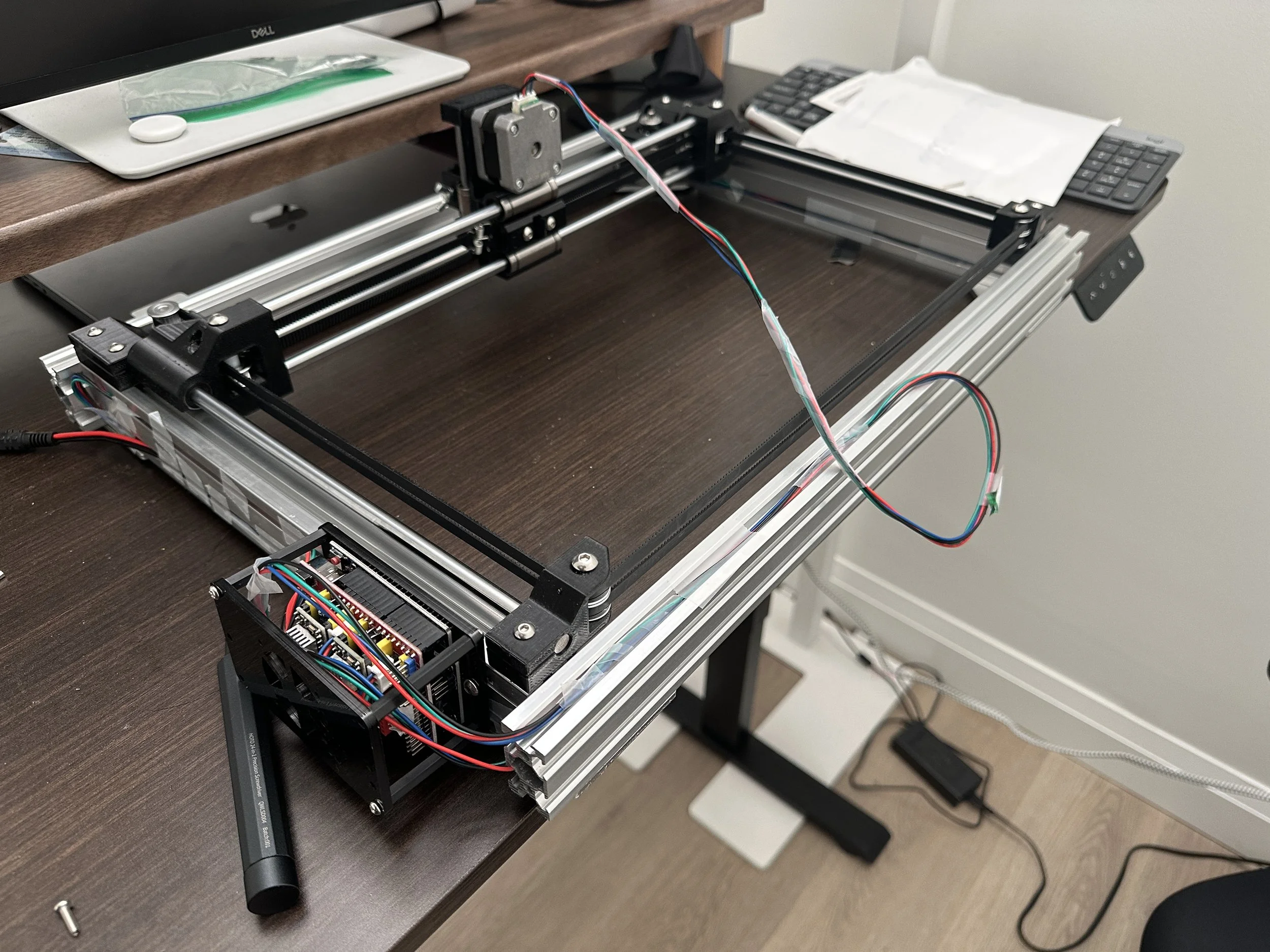
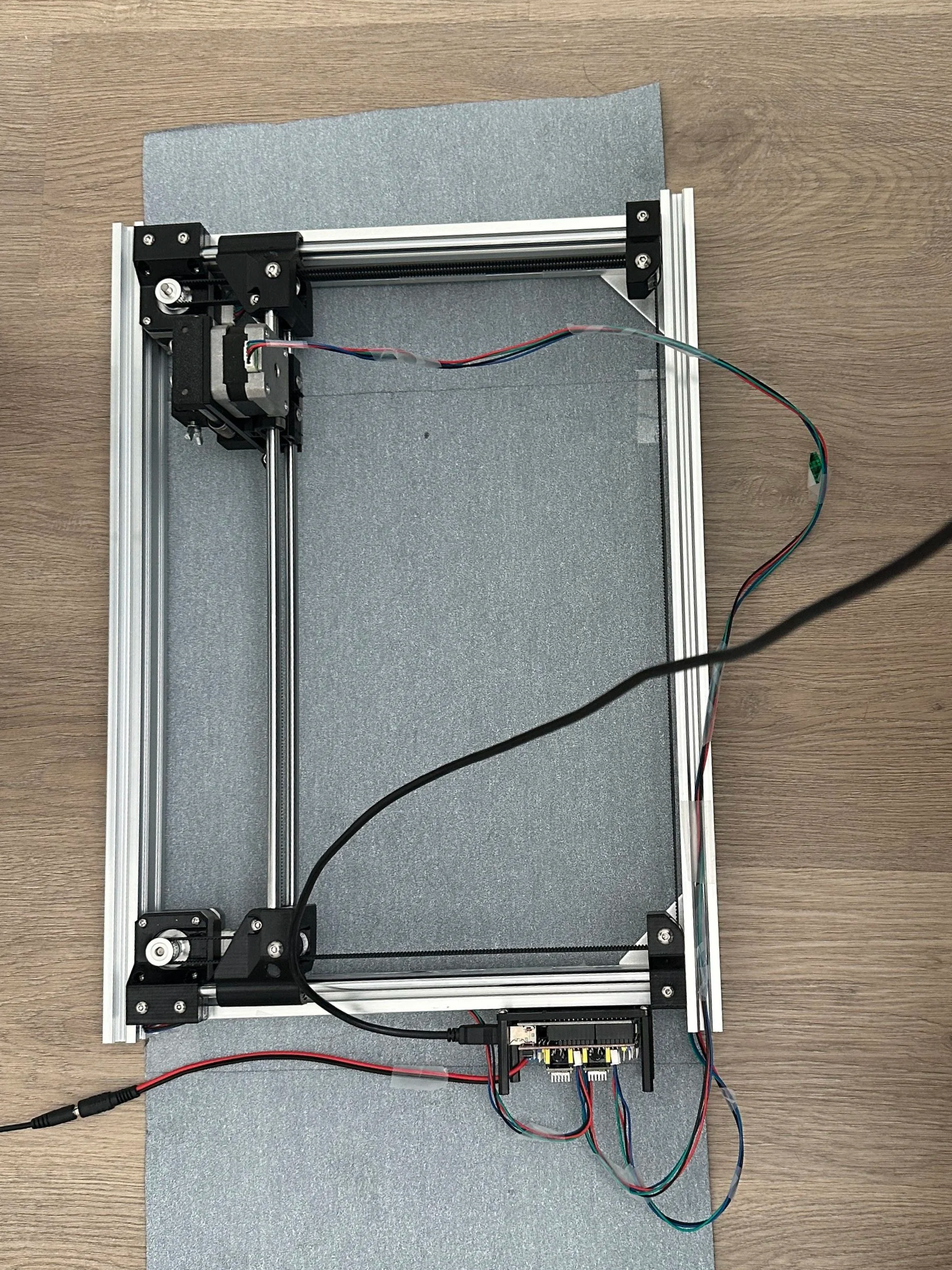
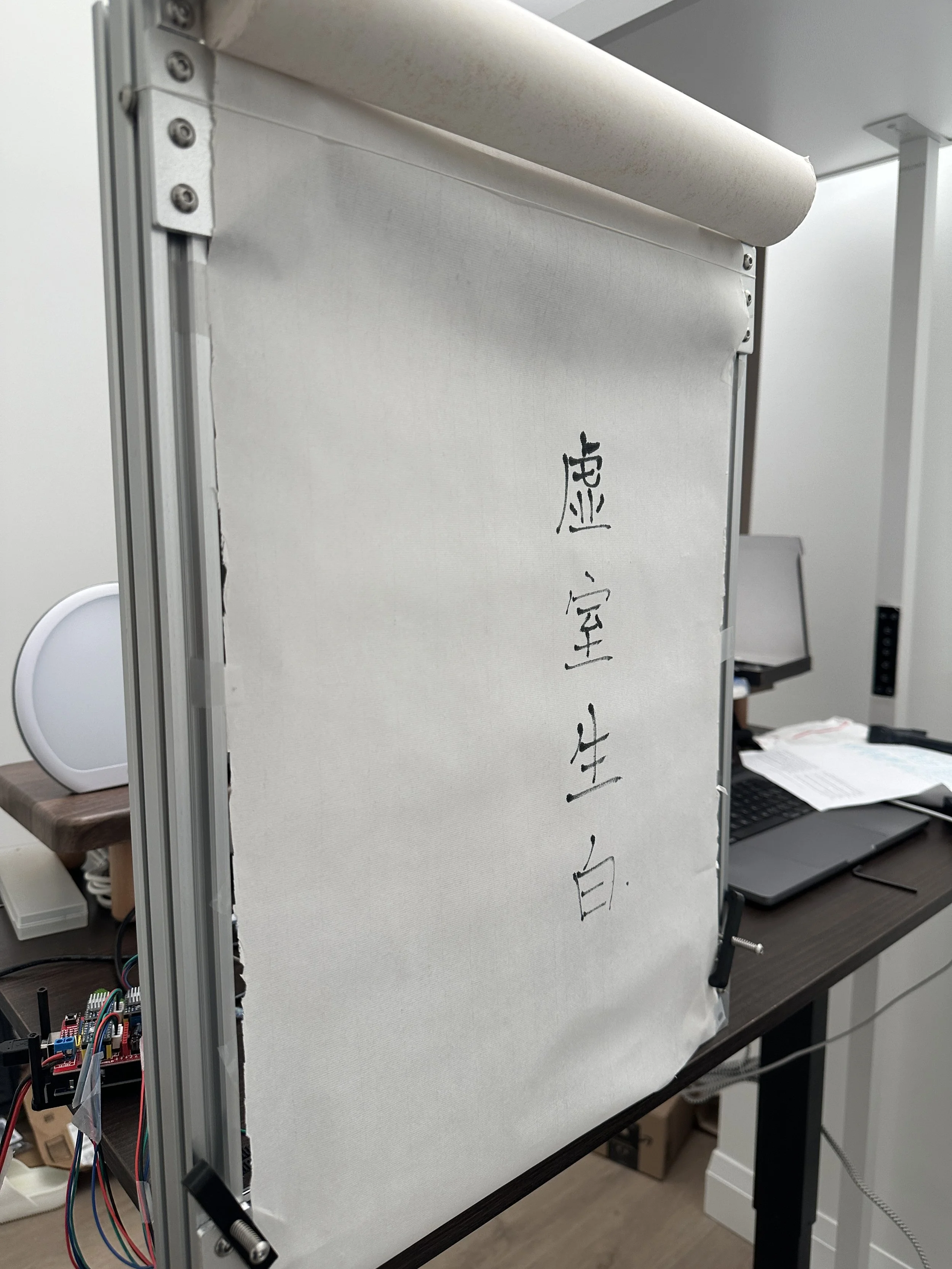
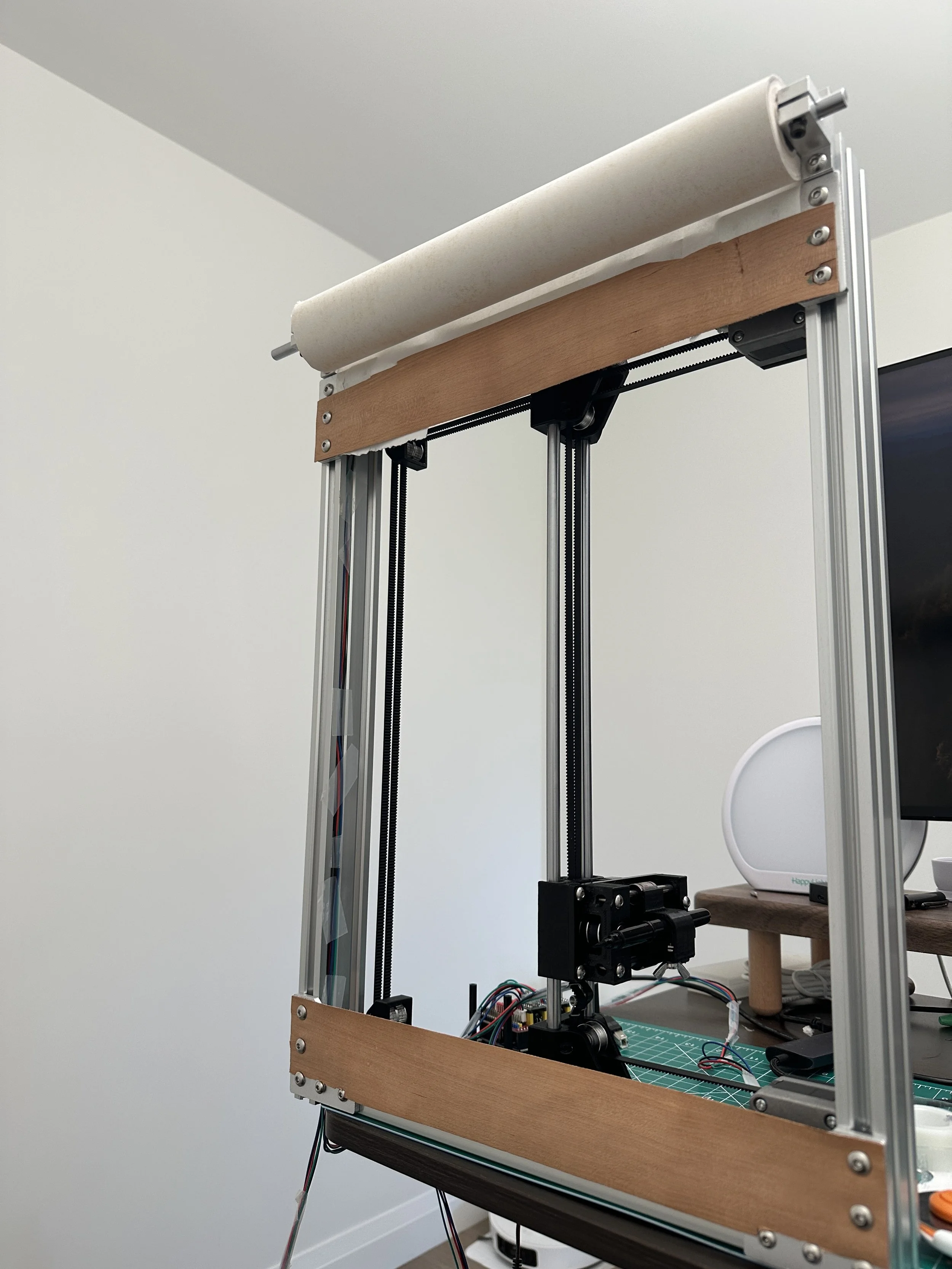
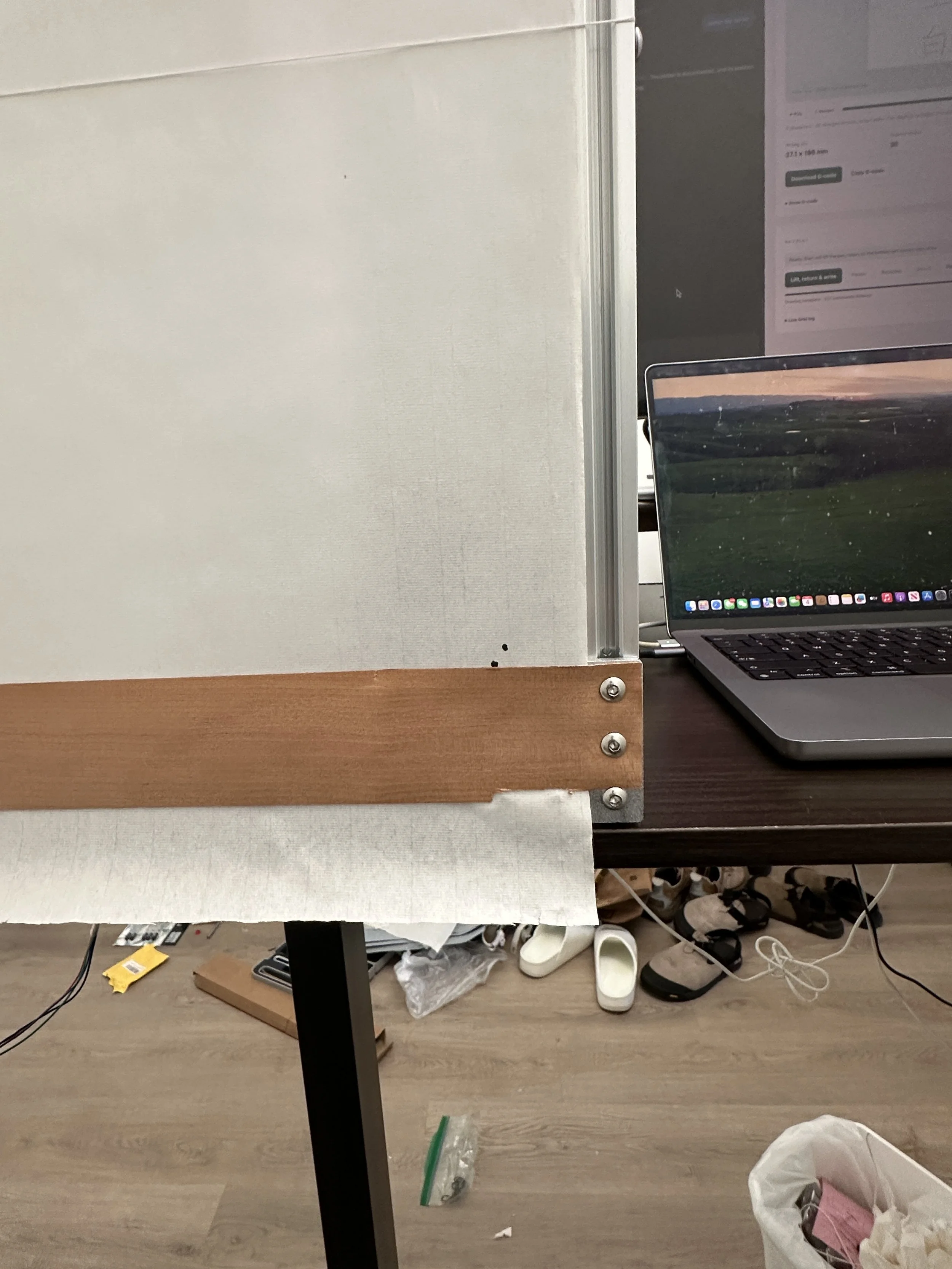
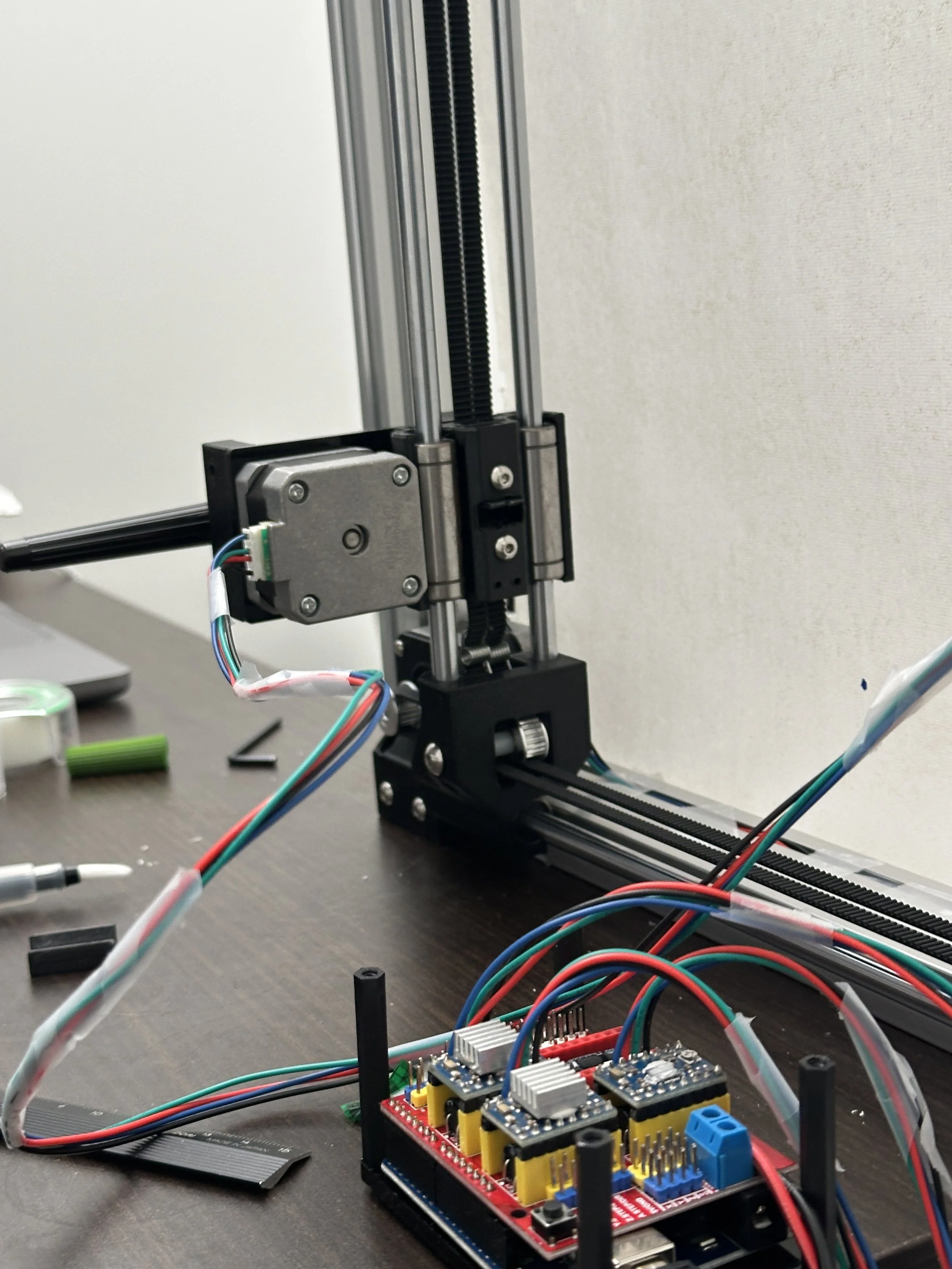
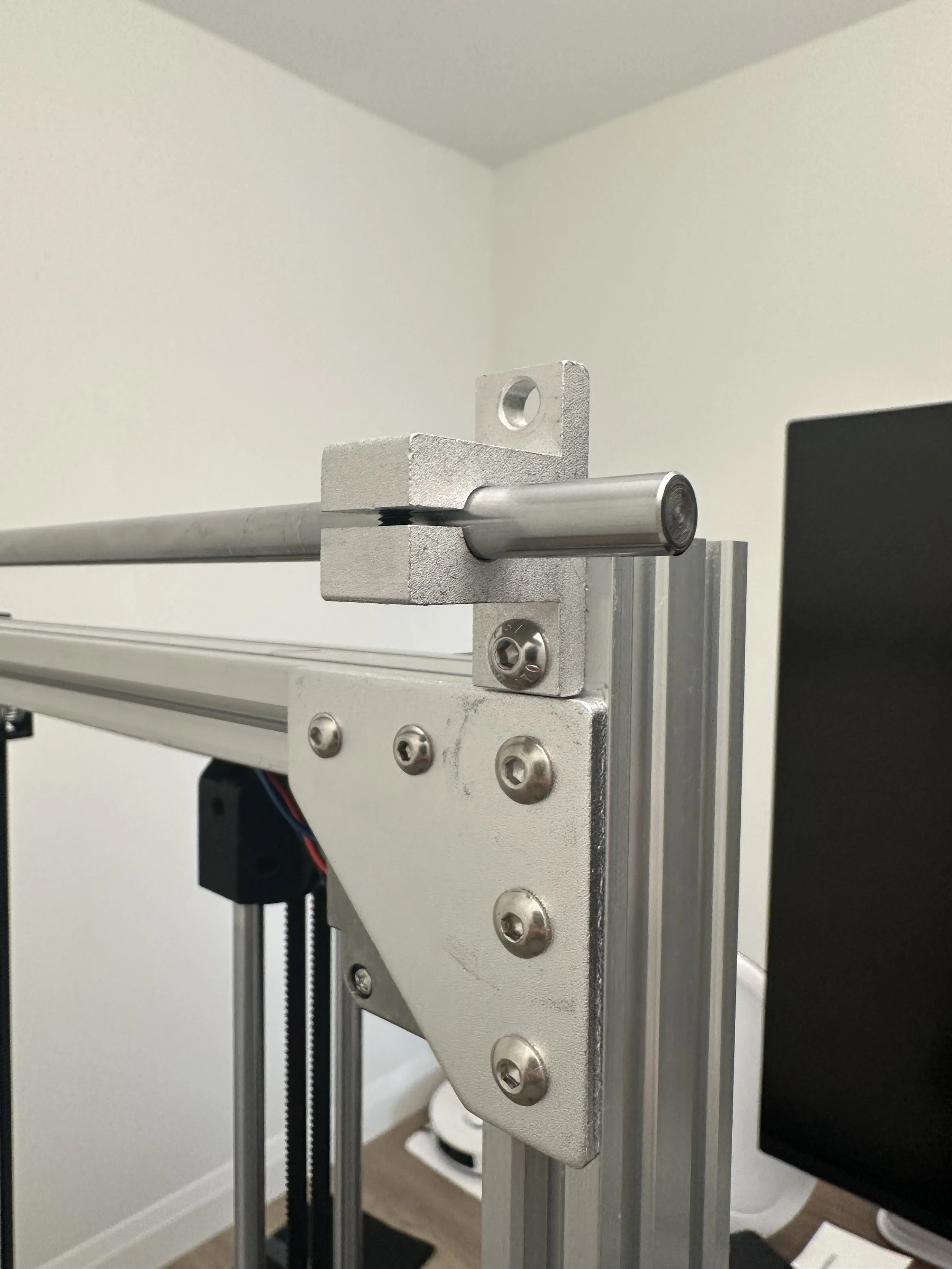
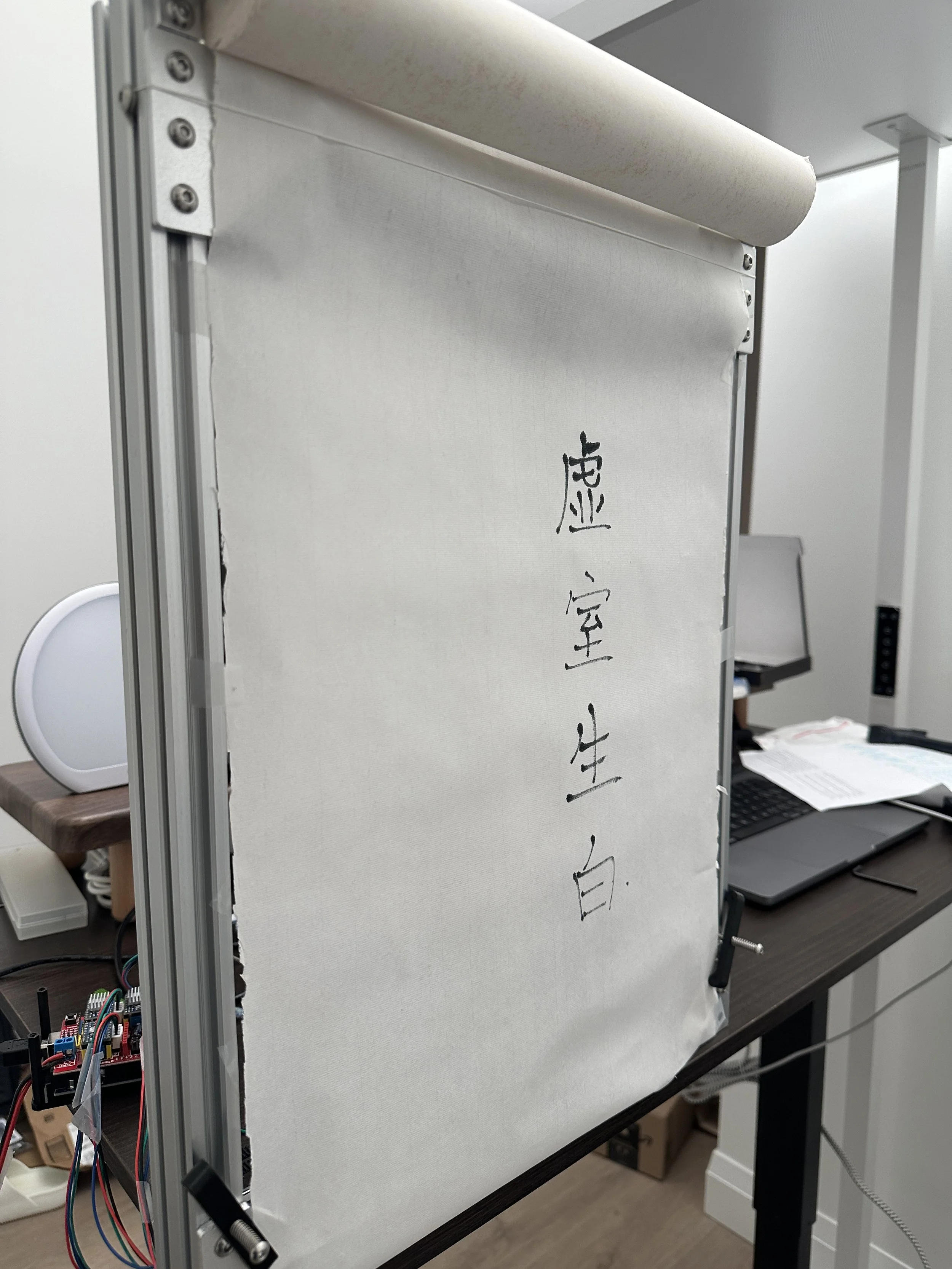
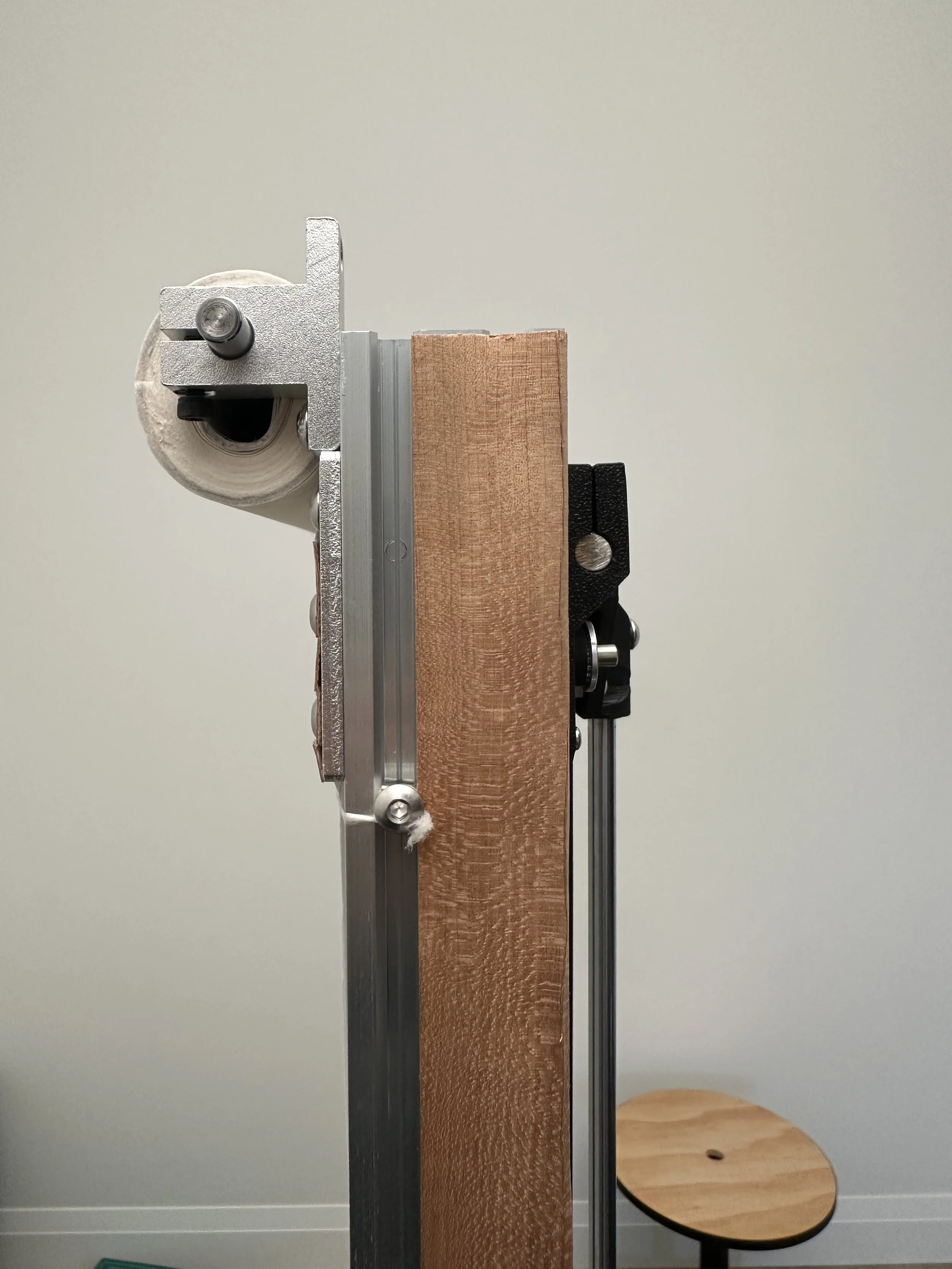
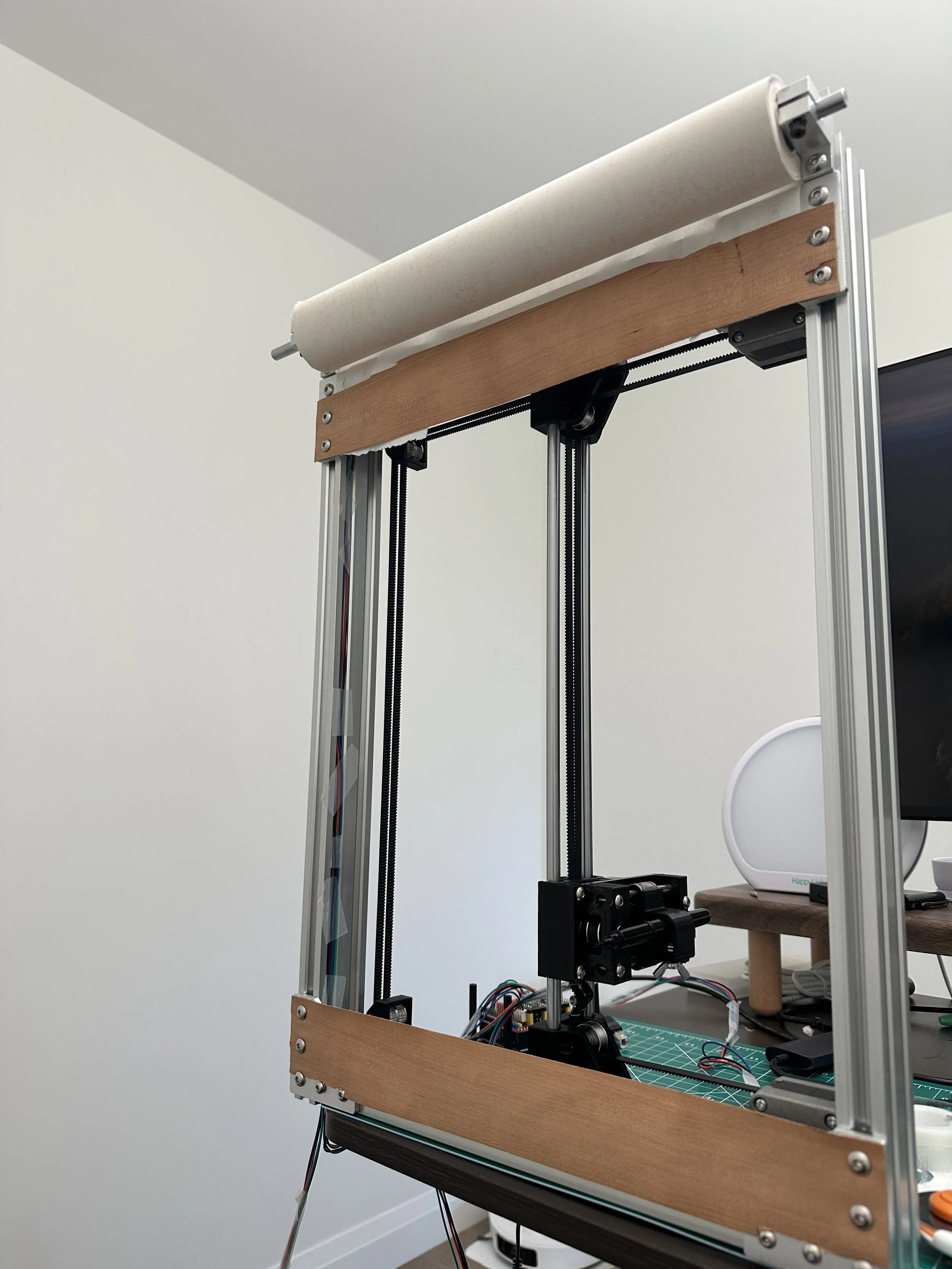
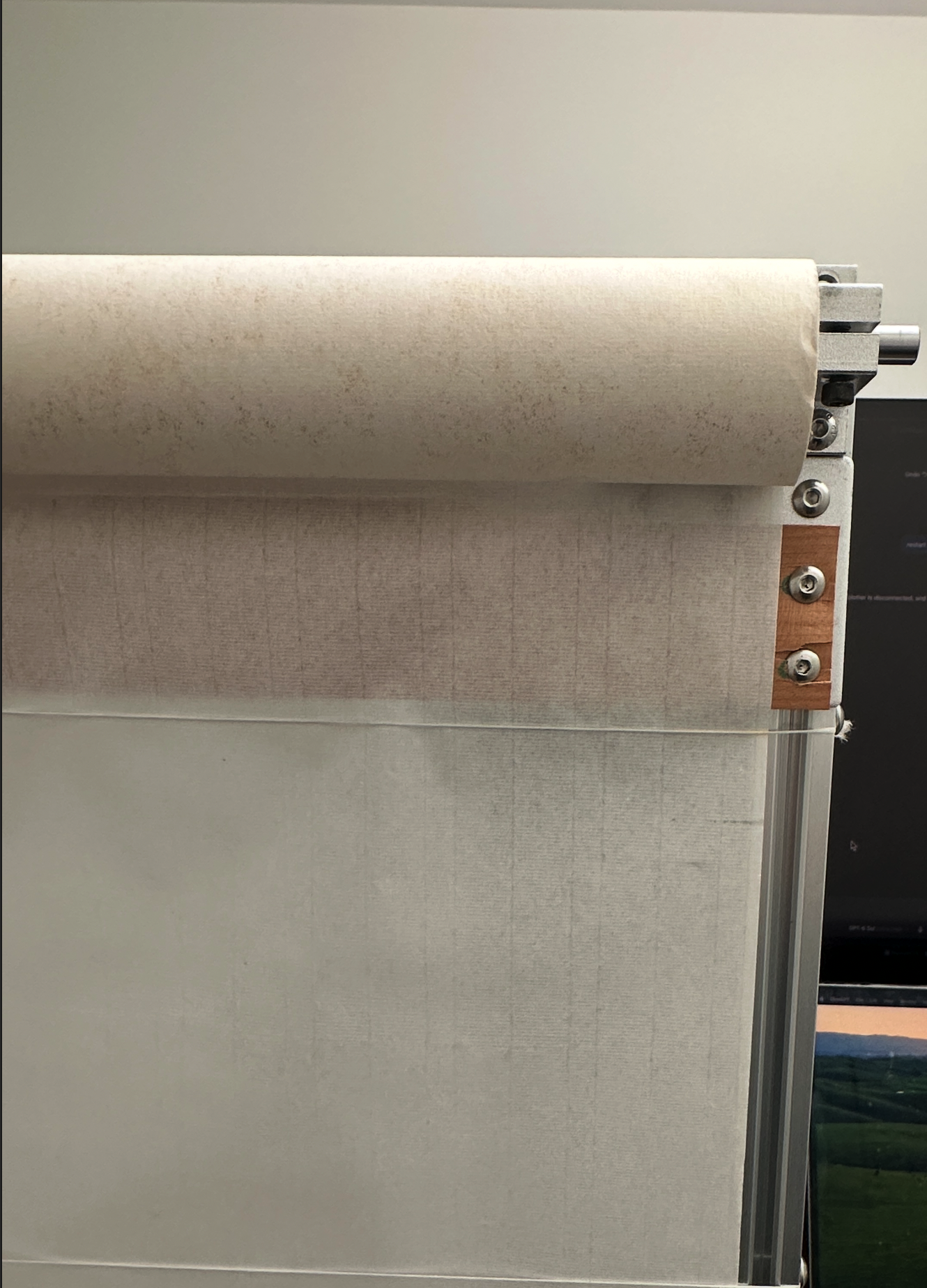
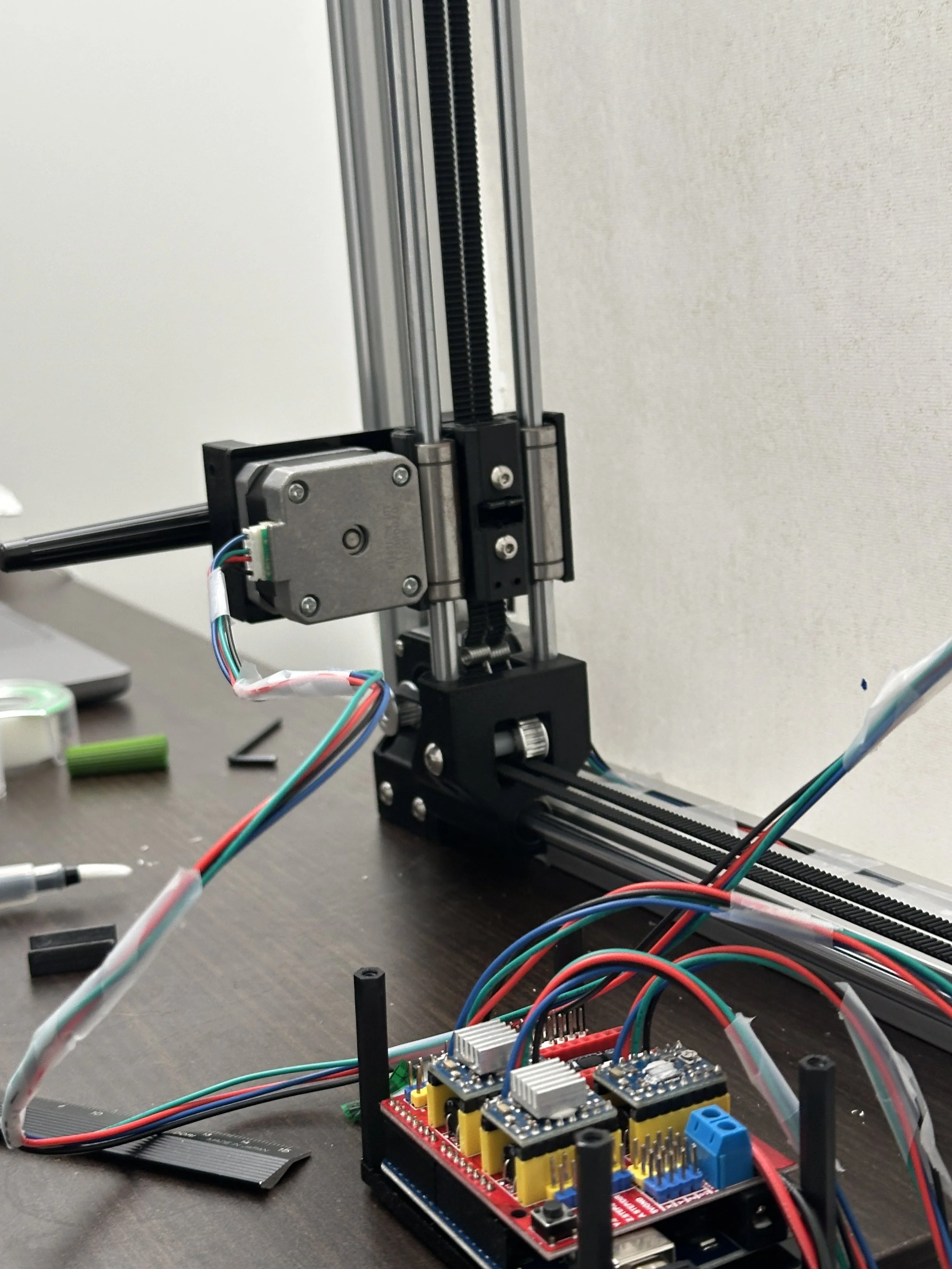
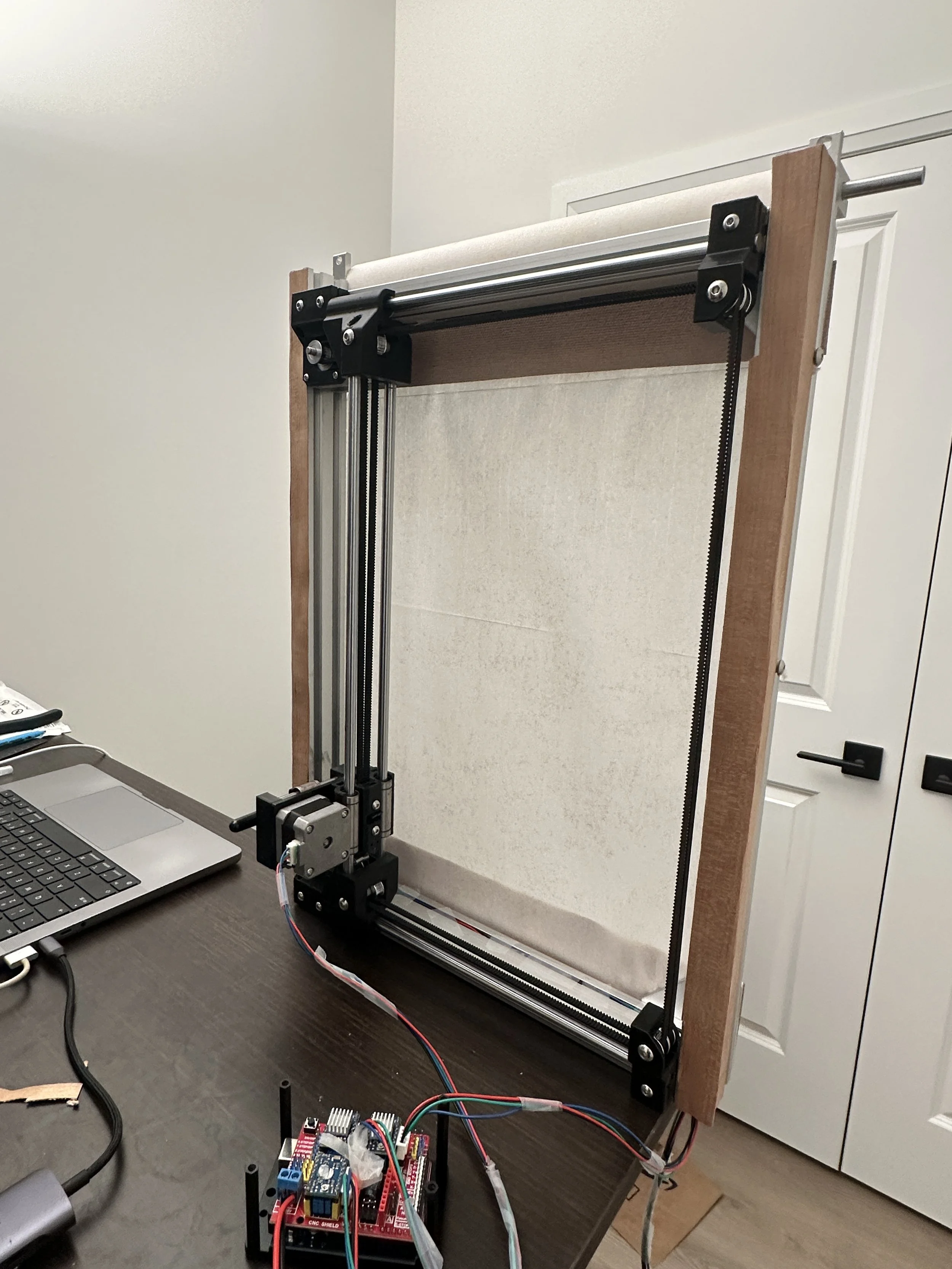
The frame is a CoreXY pen plotter, driven by an Arduino with a CNC shield and rebuilt to stand upright, with a roll of Xuan paper (宣纸) hung in front of the drawing area. The G-code is mirrored, so the pen writes on the back of the sheet and you never see the machine. From the front, each stroke seems to appear on its own as the ink soaks through. To keep that sense of wonder and slowness, the machine takes its time, one character takes about 45 seconds, so four take about as long as a pot of tea takes to steep.
The software runs locally, through a controller interface I co-created with Codex. The hard part is cursive (草书): a font only describes how a character looks, not how to draw it. So the backend renders each glyph as an image, traces its centreline and orders the branches into strokes a pen can follow, using the regular character's stroke order as a guide. The strokes are then laid out, mirrored and sent to the plotter as G-code.
Living with it
Still Feed is still a deisng prob prompting for my own observations and feedbacks, and the real test is living with it. Over the coming months I want to keep it on my own wall, plot all four sheets, and pay attention to what changes. Do I reach for my phone less in the morning? Does a sheet that says “nothing pressing”, feel like something I can trust? And when the frame gets it wrong, what does a wrong answer feel like when it is written in ink and can't be taken back?
This is also where my research interests meet. Still Feed builds on calm technology, the idea that good technology moves between the centre and the edge of our attention. It builds on slow technology, which designs for reflection and moments of rest rather than efficiency. And it follows a long line of tangible and ambient interfaces that bring information off the screen and into the physical room. And of course, along with my growing wish for a mindful screenless life. What is new now is the LLM models can read almost everything about our days, which makes an old question more urgent is not what a machine can show us, but what it should hold back, and in what form it should hand us the rest.
Taking this project as a starting point, I want to keep exploring how AI can take physical, slow and quiet forms in a home environment, and what artificial mindfulness could mean as a design goal rather than a feature.